Curriculum and Learning
Curriculum and Learning
A rich and ambitious Primary curriculum, helping children grow in knowledge, confidence and character.
At Trinity Primary, our curriculum gives children the strong foundations they need for each next step in school life. From Reception onwards, pupils are supported to become confident readers, thoughtful writers, secure mathematicians and curious learners.
Learning is carefully planned so that pupils revisit important knowledge, build vocabulary, practise key skills and grow in independence over time. We want children to enjoy learning, understand the world around them and develop the confidence to flourish as part of the Trinity journey from Reception to Year 11.
Learning at Trinity is built carefully over time. Children develop knowledge, vocabulary, confidence and character as they move through Primary and prepare for the next stage of their education.
What learning looks like at Trinity Primary
Our curriculum follows the National Curriculum and is enriched by the wider knowledge, experiences and values that help pupils live life in all its fullness.
We want pupils to know more, remember more and use what they have learned with increasing confidence. This means learning is not only about covering topics. It is about helping children build secure understanding, practise important skills and make meaningful links across subjects.
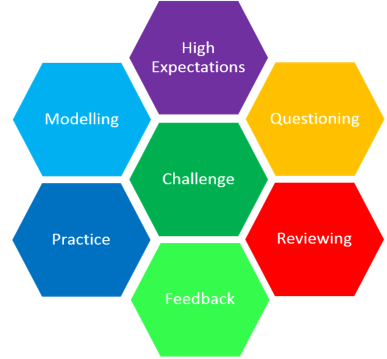
Teaching and learning at Trinity is shaped by seven key principles: high expectations, questioning, reviewing, feedback, practice, modelling and challenge. These principles help teachers plan carefully, support pupils effectively and encourage children to take an active role in their learning.
Strong foundations
Reading, writing, mathematics, phonics, vocabulary and communication are central to children’s early and ongoing success.
Rich wider learning
Pupils learn through religious education, science, history, geography, art, design and technology, music, physical education, computing and wider experiences.
Character and confidence
Children are encouraged to discuss ideas, ask questions, show resilience, take responsibility and grow in independence.
Ready for the next step
Learning builds carefully from Reception to Year 6, helping pupils move forward with confidence as they prepare for secondary school.
Reception: the beginning of the Trinity journey
In Reception, children follow the Early Years Foundation Stage framework. They learn through a careful balance of adult led teaching, purposeful play, exploration and child initiated learning.
Children are supported to build positive relationships, become more independent, develop curiosity and grow in confidence. Daily teaching in reading, writing and mathematics sits alongside rich provision that helps children explore, practise, speak, listen, imagine and learn through experience.
Reception is where children begin to see themselves as capable learners. It is also where they begin to develop the routines, language, relationships and confidence that support them as they move into Year 1 and beyond.
Key Stage 1: building secure foundations
In Years 1 and 2, children continue to build the core knowledge and skills that help them access the full curriculum. Reading, phonics, writing and mathematics have a strong place in the school day.
Trinity uses Little Wandle Phonics to support early reading and phonemic awareness. Children are helped to apply these skills in reading and writing so that they become increasingly confident with language, stories, vocabulary and communication.
In mathematics, pupils follow White Rose, developing fluency, problem solving and reasoning. Children learn to explain their thinking, practise key ideas and build confidence with number and mathematical understanding.
Alongside English and mathematics, pupils learn through a broad wider curriculum, including religious education, science, history, geography, art, design and technology, music, computing and physical education.
Lower Key Stage 2: growing knowledge and independence
In Years 3 and 4, pupils build on the foundations developed in Key Stage 1. They become more independent readers, writers and thinkers, with increasing opportunities to discuss ideas, explore authors’ voices, build vocabulary and deepen their understanding across subjects.
Learning is carefully sequenced so that pupils revisit important knowledge and build on what they have already learned. Children are encouraged to make connections, use subject vocabulary and explain their thinking with greater confidence.
Religious education, the wider curriculum and local context help pupils think about themselves, their community and the wider world. Pupils continue to grow academically, socially and personally as they move through Primary.
Upper Key Stage 2: preparing for the next stage
In Years 5 and 6, pupils are supported to become more confident, responsible and independent learners. This stage of Primary is especially important because it helps children prepare academically, socially and emotionally for secondary school.
Pupils continue to develop mature reading, extended writing, mathematical confidence, subject knowledge and discussion skills. They are encouraged to take more responsibility for their learning, explain their ideas clearly and approach challenge with resilience.
Upper Key Stage 2 also helps pupils grow in confidence, leadership and readiness. Children are supported to understand themselves as learners and to take pride in the progress they are making.
The bridge to Year 7
Trinity is one school from Reception to Year 11. This means that the Primary curriculum is not seen in isolation. It is part of a longer journey that helps pupils grow in knowledge, confidence, character and ambition over time.
As pupils move through upper Key Stage 2, we help them prepare for the opportunities and expectations of secondary school. This includes building independence, strengthening learning habits, developing confidence with new routines and helping pupils feel ready for their next step.
Our transition work helps pupils and families understand what comes next. The aim is for children to move into Year 7 feeling known, supported and confident as part of the wider Trinity community.
From Reception to Year 11: the Trinity journey helps pupils build friendships, confidence, knowledge, character and ambition over time.
Supporting every child
Every child learns differently. Staff work carefully to understand pupils as individuals, support them when they need help and challenge them when they are ready to go further.
We want pupils to feel successful, but also to develop the resilience to keep going when learning feels difficult. Children are encouraged to ask questions, listen carefully, share ideas and take pride in their progress.
Where pupils need additional support, school and home work together so that children feel understood, included and able to take part fully in learning.
Curriculum maps and year group information
More detailed curriculum information, including year group curriculum maps and subject information, will be shared here where appropriate.
These documents help families understand the topics, knowledge and skills children will meet as they move through Primary.
Visit Trinity
The best way to understand learning at Trinity Primary is to see it in action.
We warmly invite families to visit, meet staff and find out more about how children learn, grow and build confidence through our Primary curriculum.